
Interval Color Wheel
What's with all these interval colors? They allow fretboard diagrams to convey more information, and aid learning and memorization by engaging different parts of the brain.
Why color-code the intervals?
Using color-coded intervals adds an intuitive dimension to learning about harmony and memorizing intervals on the fretboard. The colors make it easier to see how different chords relate to each other, and they seem to aid memorization and recall (perhaps because colors, numbers, and sound are processed by different parts of the brain).
I stumbled upon this by accident. I originally started color coding my diagrams for entirely different reasons, but as I practiced I gradually realized I was recalling the note locations by color more often than by interval name.
My original reason for color-coding intervals was to be able to make fretboard diagrams where each dot could indicate both a tonal and a modal interval at the same time. By assigning a standard color to each of the 12 chromatic intervals, a colored dot with a text label could indicate two intervals at once: by color, and by text. For example, a dot like 1 could indicate the 1 of the key and the 5 of the chord. (Or the other way around, depending on which convention is used.)
In order to really understand harmony and the fretboard, it's important to be able to look at the notes in a song from two different perspectives:
- relative to the key center (i.e. the "tonal" interval), and
- relative to the current chord (i.e. the "modal" interval).
For example, in the key of C, the note C is the tonic (1) of the key, and it's also the fifth (5) of the F chord (F-A-C). In the key of C, when playing a C note over an F chord, it can be helpful to understand the note in both of those contexts. It's kind of the "one", and it's also kind of the "five".
But in reality, I rarely actually make diagrams this way anymore. Now I typically use the same interval perspective for both color and number, so they reinforce each other.
Why the color wheel?
There didn't seem to be an existing convention for interval coloring in musical diagrams that was used consistently by anyone. Fortunately, the color wheel invented by Isaac Newton, which is used by designers to show relationships between visible colors, is commonly organized into 12 different colors with an easily understood pattern, and arranged in a consistent order following the colors of the rainbow. The circular shape is also perfect for musical intervals since they repeat at the octave. It is ideally suited to this purpose.
Understanding the interval color wheel
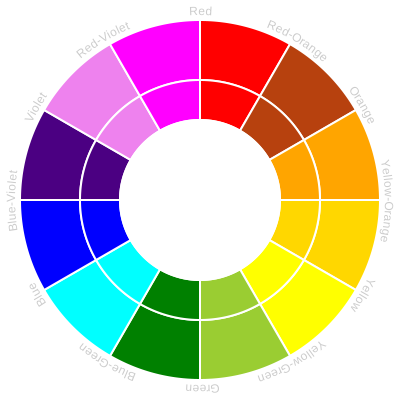
The diagram below shows a standard color wheel, where the primary colors red, yellow, and blue are spaced equally around the circle, the secondary colors orange, green, and violet (formed by blending the primary colors) are laid out between them, and the tertiary colors (red-orange, yellow-orange, etc.) are placed between those.
The 12 chromatic intervals are overlaid on the color wheel like the numbers on a clock, starting with the unison as red (the first color in the visible spectrum), and repeating at the octave (also red). Both the long name and shorthand interval numbers are shown. Intervals are given in their "flat" form by common convention, but it should be understood that the same colors would apply to enharmonic interval names; for example, an augmented fourth (♯4) would be the same color as the tritone (♭5).
The numbers from 0-12 near the center of the circle represent the number of semitones in the interval (and the number of frets it spans on one string).
Major scale and triad colors
Here's an example diagram that shows the major scale and its harmonized triad chords, in tonal colors (i.e. the colors represent the intervals of the key). Notice how each chord has its own unique color signature, which can be seen at once without having to read anything (ex. the I chord is 135 and the vi chord is 613). Furthermore, the relationship between the chords is intuitive--it's obvious that they share two notes.
The major scale is a rainbow
Many children learn that the colors of the rainbow can be remembered with the acronym "ROY-G-BIV": Red, Orange, Yellow, Green, Blue, Indigo, and Violet.
Look at the diagram above and notice that ROYGBIV is also a fair description of these colors of the major scale.
It doesn't match perfectly; in this system the 4 is technically yellow-green rather than green, for example. But it's the only green in that picture, and anyway the "ROYGBIV" description of a rainbow is also just an approximation of a continuous spectrum.
It's a useful coincidence that, in this color system, the most important scale in Western music matches so closely the friendliest way to think about the spectrum of visible light.
Use as a memory aid
When practicing scales and arpeggios, as you play each note try thinking of both the interval name and its color at the same time, visualizing the color as you play it. You may find, as I did, that this yields surprising improvements in memorization, recall, and overall understanding.
Related material
Series: Intervals
Learn the fundamental building blocks of music, and where to find interval shapes on the guitar.
Introduction to Harmony on Guitar
An introduction to the fundamentals of major key harmony by exploring the guitar fretboard with interactive animations and sound.
Chapter: Introduction to Western Harmony
This chapter in the Fretboard Foundation book gives an overview of the most practical bits of Western harmony.