
Some fretboard diagrams used on this site have a dashed yellow line between the second and third strings, like this:
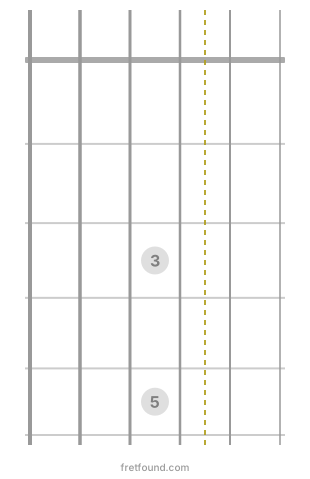
This dashed line is used to indicate the third rail.
What is the third rail?
In standard guitar tuning, the interval between the second and third strings is one fret less than the other pairs of strings.
This gap between the second and third strings is sometimes called the third rail. Partly because the interval between those two strings is a major third, and partly because (like the high-voltage third rail in a subway system) we have to pay attention when we cross it or else we'll get a shock.
What is the point of showing the third rail?
When an interval shape crosses the third rail, the note on the higher-pitched string has to move forward one fret, or the note on the lower-pitched string has to move backward one fret, compared to its main shape on other strings.
Here's an example:
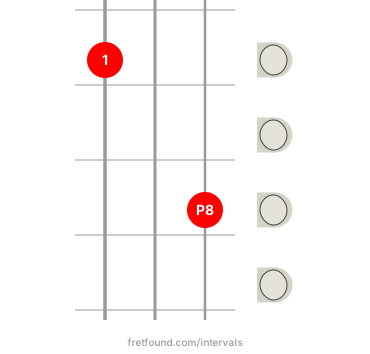
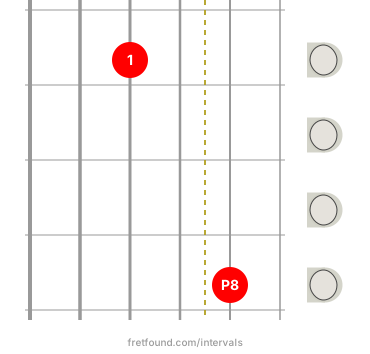
Why does this happen?
On a guitar in standard tuning, each pair of adjacent strings is tuned a perfect fourth apart (five frets), except for the second and third strings, which are tuned a major third apart (four frets). This means there is one fewer fret of distance between these two strings compared to all the others.
This tuning irregularity is a deliberate design choice. It makes common chord shapes easier to finger, but it comes at the cost of this one inconsistency that guitarists need to account for whenever a pattern crosses those two strings.