
Seconds
The building blocks of scales.
Seconds are the basic units of melody and scales. They're called steps (as opposed to the leaps taken to reach larger intervals). It's easier for human voices to sing mostly in steps rather than leaps, so most melodies consist mostly of steps, with some leaps added for color.
Minor second
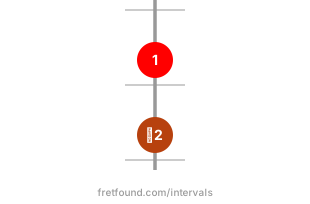
Minor second ahead
The minor second shape ahead on the fretboard is "same string, one fret ahead". About as easy as it gets.
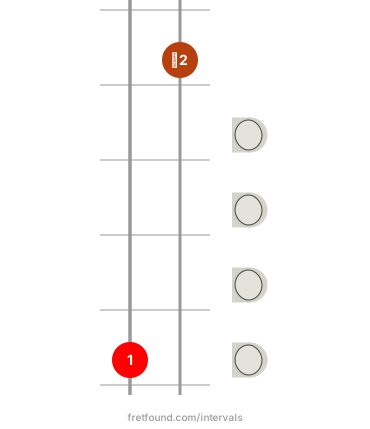
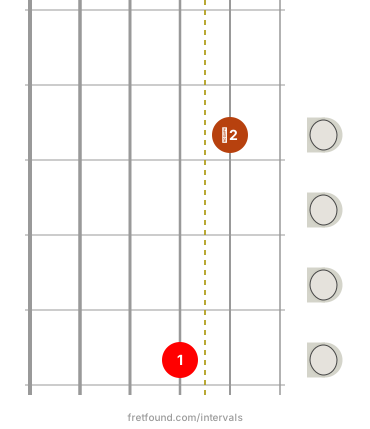
Minor second behind
The minor second shape behind is "one string over, skip three frets back". It requires stretching the index finger back, a fret beyond its natural position.
Minor second character
The minor second, also known as a half step or semitone, is the smallest interval in Western music. It's two notes right next to each other, across one fret on the same string.
Tension and resolution
Two notes that are close together like this have frequencies that overlap in ways that are complex, which our brains perceive as dissonant and tense. This tension in minor seconds creates a desire for movement; to move away from the dissonant sound of the two tones, and resolve into just one of them.
Major second
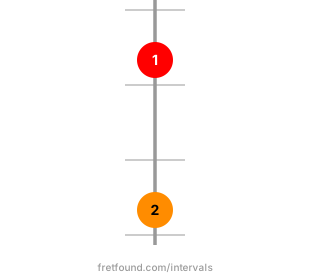
Major second ahead
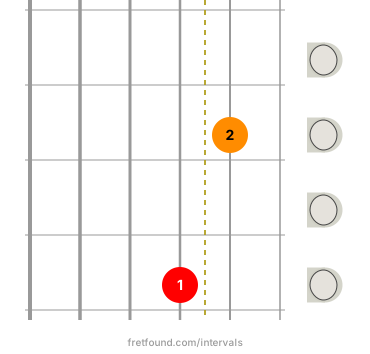
The major second shape ahead is "same string, skip a fret". Almost as easy as the minor second.
Major second behind
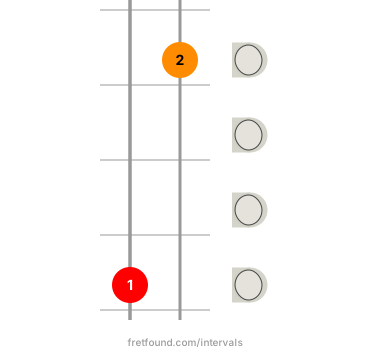
The major second shape behind is "one string over, skip two frets back". It makes good use of the finger ruler; when the lower-pitched note is under the little finger, the major second is under the index finger on the next string.
Major second character
The major second, also called a whole step or whole tone, is the smallest interval that sounds consonant to human ears. That's why most scales in Western music consist mostly of major seconds.
Assembling scales on the fretboard
Since most scales are comprised of major seconds, plus a couple of minor seconds spaced as far apart as possible, it's very useful to know the second interval shapes across strings. Then we can assemble scales from any starting location, without having to memorize any particular scale shapes.
Assembling the major scale
The major scale has been the foundation of Western music for over 400 years. Nearly everything in Western music, including the names of the intervals themselves, is derived in some way from the major scale.
Like most scales, the major scale is a pattern of seven notes that repeat at the octave. In the major scale, there is a major second between every note, with two exceptions: there is a minor second between the third and fourth notes (the 3 and 4), and between the seventh note and the octave (the 7 and 1).
Another way to think of it is to imagine all the intervals lined up in a row, skipping over the minor intervals:
Notice that most skip a space, but 3-4 and 7-1 (P8) are right next to each other.
By knowing this pattern, and knowing the fretboard shapes of the major and minor seconds, we can start from any note, anywhere on the fretboard, and assemble a major scale without having to memorize an endless number of occult scale shapes and positions.
In fact, as we practice assembling scales on the fretboard in this way, we will discover and begin to remember the recurring scale shapes and sounds spontaneously, without even trying. We will actually memorize them more thoroughly than if we focused on studying the scale shapes themselves.
Here is just one example:
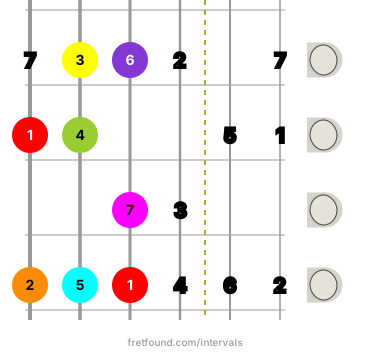
You might recognize this as a familiar major scale shape, but don't think of it that way right now. Think "one, mostly whole steps so whole step to two, whole step to three, half step between three and four so half step to four, whole step to five, whole step to six, whole step to seven, half step between seven and one so half step to one." It sounds tedious all written out like that, but with repetition it becomes one chunk of knowledge we recall automatically. Use your growing skill at finding whole steps and half steps on the fretboard (major and minor seconds) to put it all together. And then never need to memorize another major scale shape again.
Exercises
Practice exercises
-
Find ascending seconds across strings. Pick a random location on the fretboard and find major and minor second intervals on the adjacent higher-pitched string.
-
Find descending seconds across strings. Pick a random location on the fretboard. Imagine that you are starting on the higher-pitched note of the interval, and find descending major and minor second intervals on the adjacent lower-pitched string.
-
Assemble the major scale ascending across strings. Keep track of which number of the scale you are on (the "scale degree"), and remember there are major seconds between all scale degrees except for minor seconds between 3-4 and 7-1.
-
Assemble the major scale descending across strings. Start on a higher-pitched string and work your way down.