
Unisons
Find the same identical pitch all over the fretboard.
A unison describes two notes that are the exact same pitch. On guitar, unisons are all about how the instrument is tuned, and where to find the same pitch all over the fretboard.
Unison shapes
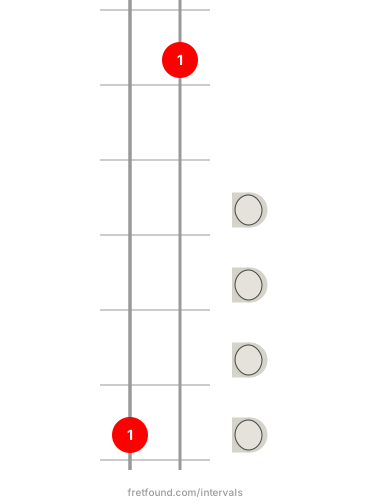
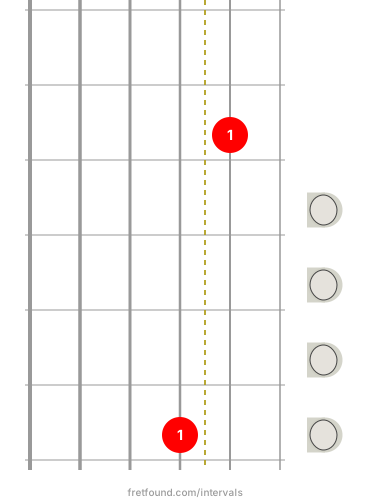
The unison shape on the fretboard is "one string over, skip four frets back". As always, when interval shapes cross the third rail between strings 2 and 3, the higher-pitched note moves forward one fret.
Unisons and guitar tuning
The unison fretboard shapes will be familiar to anyone who has tuned a guitar without an electronic tuner. In most cases, stopping a string at the fifth fret gives the same pitch as the next open string, except for string 3, which must be stopped at the fourth fret to get the same pitch as the open string 2.
Pitches, not pitch classes
Remember that a pitch class is a note in any octave, like "C", and a pitch is a note in a specific octave, like "C4". Unison shapes identify the exact same pitch at different locations on the fretboard. It's important to distinguish this from octaves, which can be used to find a pitch class around the fretboard.
Unisons along the fretboard
The unisons show how to move forward and backward on the fretboard. Unlike the other intervals, unisons can't be played practically without moving the hand out of position.
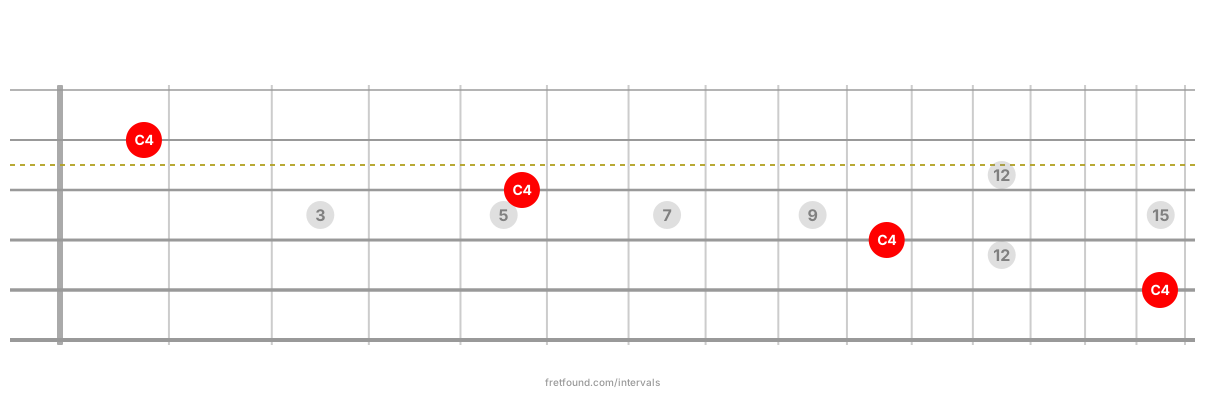
Unison shapes cut across the fretboard in a long diagonal line. It can be surprising the first time we realize how many places on the fretboard we can play the exact same pitches. Absolutely identical voicings of the same chord fragments can be found in many places, one string over and four or five frets apart. This would be more obvious if it weren't for the fact that the chord grips tend to be different, because they often cross the third rail.
Exercises
Practice exercises
-
Find unisons for a random note. Play a note on the guitar at random, then locate the unisons ahead of it and behind it on the fretboard, until you run out of frets.
-
Find a specific pitch on the fretboard. Choose a pitch like "C4" (middle C) and find all of its unisons, focusing on the note name as you play it. Notice the fret markers around it, to help remember its location.